The Top 10 Business Strategy Trends Shaping 2026
-
Home
-
Business Strategy & Growth
-
The Top 10 Business Strategy Trends Shaping 2026

The Top 10 Business Strategy Trends Shaping 2026
The top 10 business strategy trends shaping 2026, providing insights for executives, entrepreneurs, and consultants.

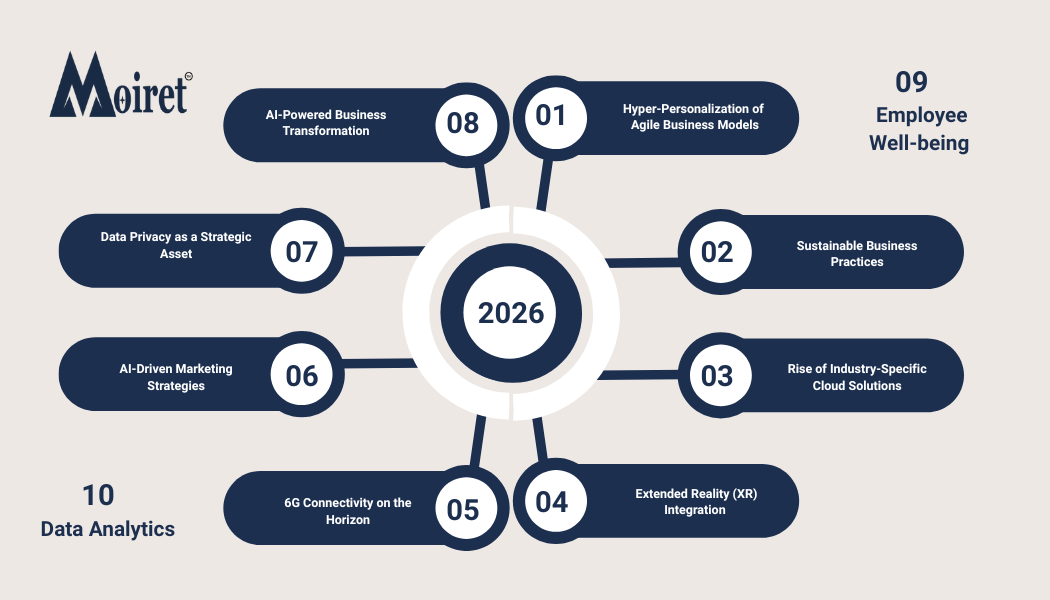
The business landscape in 2026 is to be characterize by rapid technological advancements, shifting consumer expectations, and a heigh focus on sustainability. To remain competitive, organizations must adapt their strategies to align with these evolving dynamics.
This article helps into the top 10 business strategy trends that are defining success in 2026.
1. AI-Driven Decision Making
Artificial Intelligence (AI) has transitioned from a futuristic concept to a core component of business strategy. In 2026, nearly 49% of technology leaders report that AI is fully integrated into their companies' core business strategies.
Key Applications:
- Predictive Analytics: Anticipating market trends and consumer behavior.
- Automated Decision-Making: Streamlining operations and reducing human error.
- Personalization: Tailoring products and services to individual customer preferences.
First Case Study: OpenAI's strategic shift towards enterprise growth, including partnerships with companies like Spotify and Mattel, highlights the increasing reliance on AI to enhance business operations.
2. Purpose-Driven Business Models
The consumers and employees are increasingly tend towards brands that align with their values. Purpose-driven companies should not only focus on profitability but also on making a positive social and environmental impact in 2026.
Benefits:
- Enhanced Brand Loyalty: Consumers are more likely to support brands that reflect their values.
- Attraction and Retention of Talent: Employees prefer working for organizations that prioritize purpose over profit.
- Long-Term Sustainability: Companies with a clear purpose are better positioned for long-term success in term of product or services.
Example: Patagonia's commitment to environmental sustainability has strengthened its brand and customer loyalty.
3. Agile Strategy Development
The traditional approach of rigid, long-term planning is being replaced by agile strategy development. Organizations are adopting flexible, iterative processes to respond swiftly to market changes.
Key Features:
- Continuous Feedback Loops: Regularly assessing and adjusting strategies based on real-time data.
- Cross-Functional Collaboration: Encouraging collaboration across departments to foster innovation.
- Rapid Prototyping: Quickly developing and testing new ideas to stay ahead of competitors.
Insight: As organizations face economic pressures and technological advancements, the need for agility in strategy development becomes paramount.
4. Generative AI in Business
Generative AI is revolutionizing content creation, product design, and customer service. By automating complex tasks, businesses can enhance creativity and efficiency.
Applications:
- Content Generation: Producing marketing materials, reports, and social media posts.
- Product Design: Creating prototypes and simulations to accelerate development.
- Customer Service: Implementing AI-driven chatbots to handle customer inquiries.
Trend: Generative AI is transforming content marketing and creative processes for businesses, allowing for more personalized and efficient customer interactions.
5. ESG Integration in Core Strategy
Environmental, Social, and Governance (ESG) factors are increasingly influencing business strategies. Companies are integrating ESG considerations into their core operations to meet regulatory requirements and consumer expectations.
Strategies:
- Sustainable Sourcing: Procuring materials and services from environmentally responsible suppliers.
- Social Impact Initiatives: Investing in community development and employee well-being.
- Governance Practices: Ensuring transparency and accountability in decision-making processes.
Challenge: Despite the growing emphasis on ESG, only 21% of CFOs report that their companies are working towards full integration of ESG into their core business strategies.
6. Customer-Centric Digital Transformation
Digital transformation efforts are increasingly focused on enhancing customer experiences. Organizations are leveraging technology to understand and meet customer needs more effectively.
Approaches:
- Data Analytics: Analyzing customer data to gain insights into preferences and behaviors.
- Omnichannel Engagement: Providing seamless experiences across various digital platforms.
- Personalization: Tailoring products, services, and communications to individual customers.
Insight: The future of digital transformation is customer-centric, with organizations putting customers at the forefront of their strategies.
7. Hybrid Work and Organizational Resilience
The shift towards hybrid work models has necessitated changes in organizational strategies. Companies are focusing on building resilience to navigate uncertainties and maintain productivity.
Key Elements:
- Flexible Work Arrangements: Allowing employees to work from various locations.
- Digital Collaboration Tools: Implementing technologies to facilitate communication and collaboration.
- Employee Well-being: Prioritizing mental health and work-life balance.
Trend: The workplace in 2026 will be more hybrid work and increase full time layoffs, highlighting the need for organizations to adapt and build resilience.
8. Strategic Mergers and Acquisitions
Mergers and acquisitions (M&A) continue to be a strategic tool for growth and diversification. In 2026, the M&A landscape is influenced by pro-business policies and private equity involvement.
Trends:
- Private Equity Dominance: Private capital-backed firms leading the way in M&A activities.
- Strategic Growth: Companies pursuing M&A to expand into new markets and acquire new capabilities.
- Regulatory Considerations: Navigating regulatory environments to ensure successful transactions.
Example: The recent 2026 the $10.9 billion acquisition of Comerica by Fifth Third Bank demonstrates the ongoing trend of consolidation in the banking sector.
9. Data-Driven Innovation
Organizations are increasingly relying on data to drive innovation. By analyzing data, businesses can identify opportunities for new products, services, and processes.
Strategies:
- Predictive Analytics: Using data to forecast trends and inform decision-making.
- Customer Insights: Gathering and analyzing customer feedback to guide innovation.
- Collaborative Platforms: Sharing data across departments to foster innovation.
Trend: Data-driven innovation is essential for businesses to stay competitive in 2026, as it allows for informed decision-making and rapid adaptation to market changes.
10. Resilience and Risk Management
In an era of economic uncertainty and global challenges, organizations are placing a greater emphasis on resilience and risk management.
Approaches:
- Scenario Planning: Preparing for various potential outcomes and developing strategies accordingly.
- Diversification: Spreading investments and operations across different markets and sectors.
- Crisis Management: Developing and implementing plans to respond to unforeseen events.
Insight: Building resilience is crucial for organizations to navigate the complexities of the modern business environment and ensure long-term success.
Stay Ahead with Moiret
Discover the key strategies, innovations, and trends that will define successful businesses in 2026.
“The best way to predict the future of business is to create it.”

The business strategies of 2026 are characterize by a blend of technological innovation, customer-centric approaches, and a commitment to sustainability. Organizations that embrace these trends are better positioned to thrive in an increasingly complex and dynamic marketplace. By integrating AI, focusing on purpose-driven models, adopting agile methodologies, and prioritizing resilience, businesses can navigate the challenges of 2026 and beyond.
Share this post:
Leave a comment
Your email address will not be published. Required fields are marked *